




When an Amazon delivery accident in St. Louis occurs, the path to securing fair compensation presents unique challenges. You may assume the responsible party is the global retail giant, but Amazon has structured its delivery network to create layers of legal distance between itself and the drivers who deliver its packages.
An injury claim after a collision is not just about the driver. It often involves the driver’s direct employer, a little-known company called a Delivery Service Partner (DSP), and Amazon itself.
Determining each party’s degree of responsibility is a complex task that requires a detailed investigation into the crash and the corporate structure designed to shield Amazon from the driver’s actions.
Call (918) 398-0934 or contact us online today for a free consultation.
Key Takeaways for Amazon Delivery Accident in St. Louis
- Amazon often avoids direct employment of its drivers, instead contracting with third-party companies.
- Victims may file a claim against the driver, the DSP, and Amazon, as all three parties may share liability.
- Evidence of Amazon’s control over drivers—like requirements for routes, delivery metrics, and tracking performance—is central to connecting the company to a crash.
- Pressure from demanding delivery schedules can contribute to unsafe behaviors, including speeding and distracted driving.
- A personal injury lawyer can identify all responsible parties and counter the legal strategies large corporations use to deflect blame.
Understanding Amazon’s Delivery Service Partner Model
After a commercial vehicle collision, identifying the defendant seems straightforward. If a branded truck causes a crash, the company whose logo is on the vehicle is typically the focus of the claim.
Amazon, however, complicates this through its DSP program, a business model that introduces layers between the corporation and the person at the wheel.
This system is a cornerstone of how the company attempts to reduce its legal responsibility when something goes wrong on the road. In some cases, courts are becoming skeptical of Amazon’s attempts to avoid liability through this model.
A successful claim often requires a thorough understanding of this structure and a strategy to hold all negligent parties accountable for their role in an Amazon delivery accident in St. Louis.
The Difference Between the Driver, the DSP, and Amazon
The person driving the Amazon-branded van that hit you likely doesn’t work for Amazon directly. Instead, they’re an employee of a separate, smaller company. Amazon contracts with hundreds of these local DSP companies across the country to manage the final leg of its deliveries.
The driver answers to the DSP, the DSP answers to Amazon, and Amazon claims the DSP is an independent contractor. This separation can function as a legal tactic.
When an accident happens, Amazon’s first line of defense is to point the finger at the DSP, arguing that the smaller company—not Amazon—is the party responsible for the driver’s actions.
How Amazon Retains Control Despite the DSP Model
While Amazon argues its DSPs are independent, evidence often shows the opposite. The global retailer frequently exerts significant control over its DSPs and their drivers, which is a critical element in proving the company’s liability. A lawyer works to expose the true nature of this relationship.
You may be able to hold Amazon responsible for a crash by showing it functions as a joint employer. Evidence often reveals that Amazon dictates key parts of the driver’s job, undermining the claim of independence.
This control is exercised in several key ways:
- Hiring and Firing: Amazon often sets the criteria for hiring drivers and reserves the right to disqualify a driver from its routes, effectively giving it firing power.
- Training Protocols: Drivers must typically complete Amazon-mandated training programs that dictate how they perform their duties.
- Performance Monitoring: Amazon uses sophisticated surveillance technology, like the Mentor app, to track driving behaviors, including speed, braking, and phone usage.
- Route and Schedule Dictation: The company’s software can control the delivery routes, package loads, and grueling schedules that drivers must follow.
This high level of control can make Amazon legally responsible for the actions of DSP drivers. A claim can argue that if Amazon acts like an employer, it carries the responsibilities that come with that role.
Proving Liability in a St. Louis Amazon Van Wreck
To obtain compensation, your personal injury attorney needs to prove that one or more parties acted negligently. In the context of an Amazon delivery accident in St. Louis, this involves more than just showing the driver made an error.
It requires building a case that links the driver’s mistake back to the operational demands and control exercised by both the DSP and Amazon.
Potential Defendants in Your Claim
After an Amazon van hits you, your lawyer investigates the crash to identify all parties who contributed to your injuries. Pursuing a claim against multiple defendants is common in these cases because responsibility is often shared.
The three main parties include:
- The Driver: The individual driver is accountable for their direct actions, such as speeding down Gravois Avenue, running a red light in the Central West End, or failing to yield while pulling out of a spot near Forest Park.
- The Delivery Service Partner: The DSP may hold liability as the driver’s direct employer. A lawyer investigates whether the DSP engaged in negligent hiring practices, provided inadequate training, or failed to maintain its vehicles properly.
- Amazon: The retail giant may also be a defendant. An attorney gathers evidence to demonstrate Amazon’s control over the driver and its role in creating the conditions that led to the crash.
Connecting Amazon’s Demands to Dangerous Driving
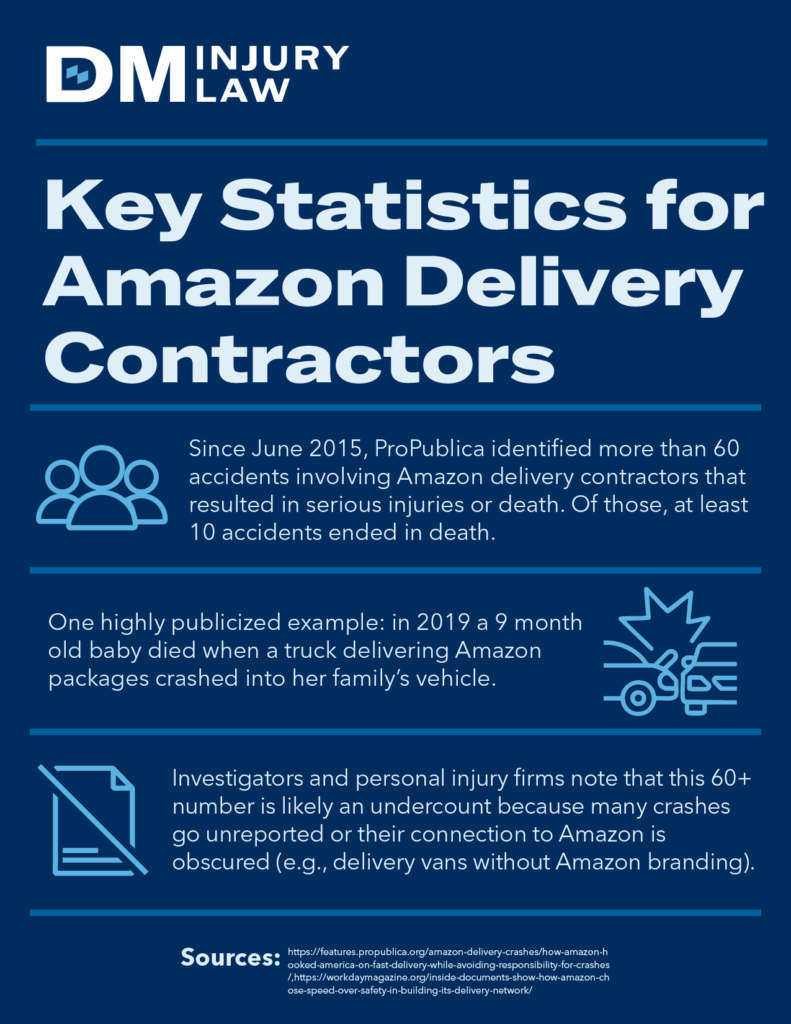
A key part of holding Amazon accountable involves showing how its corporate policies may create a hazardous environment on St. Louis roads. The company’s focus on speed and efficiency can pressure drivers to cut corners on safety, a factor that can lead directly to a collision.
Your claim for an Amazon delivery accident in St. Louis may connect the wreck to specific corporate pressures. One of the most significant and common factors is unrealistic delivery quotas.
Amazon’s algorithms may assign a high volume of packages for delivery in a single shift, leaving drivers with very little time per stop. This immense pressure can lead to dangerous behaviors as drivers rush to avoid falling behind schedule and facing penalties from their DSP or Amazon.
Specific negligent actions linked to these pressures include:
- Excessive Speed: Drivers may speed through residential neighborhoods like The Hill or Soulard to meet tight deadlines.
- Aggressive Maneuvers: The pressure to deliver quickly can lead to making aggressive and unsafe turns on busy roads like Kingshighway Boulevard.
- Inattention to Surroundings: Rushing between stops causes some drivers to fail to look carefully for pedestrians and cyclists.
- Technological Distraction: A driver may become dangerously distracted while operating the Mentor app or other Amazon-mandated software behind the wheel.
A lawyer argues that Amazon is aware of the risks its policies create. By demanding such a grueling pace, the company contributes to the conditions that increase the likelihood of accidents.
Your claim asserts that Amazon’s negligence lies not just in a single driver’s error, but in the entire system it designed.
Assembling the Evidence To Build a Strong Claim
A successful injury claim hinges on the quality and strength of the evidence your attorney presents. After an Amazon delivery accident in St. Louis, gathering proof requires a deeper investigation into the driver’s history, the DSP’s operations, and Amazon’s internal data.
Your legal team will act quickly to preserve and obtain crucial evidence that defense attorneys for a major corporation might otherwise try to keep hidden. Each piece of information helps paint a complete picture of fault, connecting the actions of the driver to the pressures imposed by Amazon.
Information and Documents Your Lawyer Collects
The investigation begins right after you hire an attorney. This allows your lawyer to secure evidence before it disappears. Some items are time-sensitive, so acting quickly strengthens your position.
Beneficial evidence includes:
- Internal Company Records: Your lawyer can demand records from Amazon and the DSP, including driver logs, performance metrics, training materials, and communication logs related to delivery quotas.
- Electronic Data: Data from the delivery van’s onboard computer and the driver’s Mentor app can reveal speed, braking patterns, and other critical information from the moments before the collision.
- Driver’s History: A thorough background check may reveal a history of traffic violations or unsafe driving, indicating potential negligent hiring by the DSP.
- Witness Testimony: Your legal team can locate and interview eyewitnesses who saw the accident or who can speak to the driver’s pattern of reckless behavior.
The Importance of the Police Report
A police report provides an official, third-party account of the incident. Law enforcement officers document the scene, note visible damage, identify involved parties, and often issue citations or state their initial findings about the cause of the wreck.
Although not the only piece of evidence, it’s a foundational document in any car accident claim. You need a copy of this report as soon as it becomes available. It contains key details that your attorney uses to start the investigation.
Items an attorney looks for in a police report include:
- Factual Narratives: The report contains a description of how the responding officer believes the crash occurred.
- Party and Witness Information: It may contain contact details for everyone involved, including eyewitnesses your lawyer needs to interview.
- Citations Issued: If the Amazon driver received a ticket for a traffic violation, it provides strong evidence of their negligence.
- Diagrams of the Scene: Many police officers include a visual representation of the accident scene, including vehicle positions and points of impact.
FAQ for Amazon Delivery Accident in St. Louis
Can I Still Recover Compensation if I Was Partially at Fault?
Yes, Missouri’s pure comparative fault rule allows you to recover damages even if you’re partially to blame for the accident. Your assigned percentage of fault simply reduces your total compensation award.
An experienced attorney uses evidence to fight back against unfair attempts by the defense to shift blame onto you.
Do I Sue Amazon, the DSP Company, or the Driver?
You may have a claim against all three parties: The driver is responsible for their direct actions, the DSP is liable as the employer, and Amazon can be held responsible due to its control over the delivery operations.
An attorney investigates the relationship between the parties to determine how to structure your claim for a successful outcome.
What Makes an Amazon Delivery Accident in St. Louis So Complicated?
These cases are complex because Amazon intentionally uses its DSP model to shield itself from liability. Proving Amazon’s responsibility requires demonstrating that, despite classifying drivers as independent contractors, the company exercises sufficient control over them to be considered an employer.
This requires a deep investigation and specific legal arguments to overcome the company’s defense strategies.
What if the Amazon Driver’s Insurance Isn’t Enough To Cover My Damages?
A primary reason to pursue a claim against both the DSP and Amazon is that they have larger commercial insurance policies and corporate assets. By linking the accident to these larger entities, your attorney works to ensure there is enough coverage to compensate you for all your losses.
Why Do I Need a Lawyer After an Accident With an Amazon Delivery Van?
Amazon and its insurance carriers have vast legal resources dedicated to minimizing payouts. A personal injury lawyer who has handled cases against large corporations understands their tactics and knows how to build a case that can stand up to their defenses.
Your attorney calculates the full value of your claim and negotiates with the insurer to secure a settlement that covers your current and future medical bills, lost income, and diminished earning capacity.
They manage all deadlines and communications with opposing counsel and insurers, freeing you to concentrate on your personal recovery.
Let Us Fight for Your Compensation
The team at DM Injury Law focuses on holding corporations accountable when their systems place profits over public safety. We understand the legal arguments required to prove liability in an Amazon delivery accident in St. Louis and are prepared to fight for your rights.
Past results do not guarantee future outcomes. Every case is different and must be evaluated on its own facts.
Call (918) 398-0934 or contact us online today for a free consultation.