




If a commercial truck hit you or someone you love in the Kansas City area, you probably have one pressing question: Who is responsible? The short answer is that suing a trucking company for negligence is often the stronger legal move, because the company behind the driver typically carries far more insurance and may bear direct responsibility for the crash.
While the driver who caused the wreck may seem like the obvious target, in many cases, the trucking company, a freight broker, or even a vehicle manufacturer may share fault.
Understanding who to hold accountable can mean the difference between a settlement that barely covers your medical bills and one that actually reflects the full value of the harm you have suffered due to someone else’s negligent actions. Speak with a Kansas truck accident lawyer to clarify your legal rights and options on what to do next.
Call (405) 295-0622 or contact us online today for a free consultation.
Key Takeaways about Suing a Trucking Company for Negligence
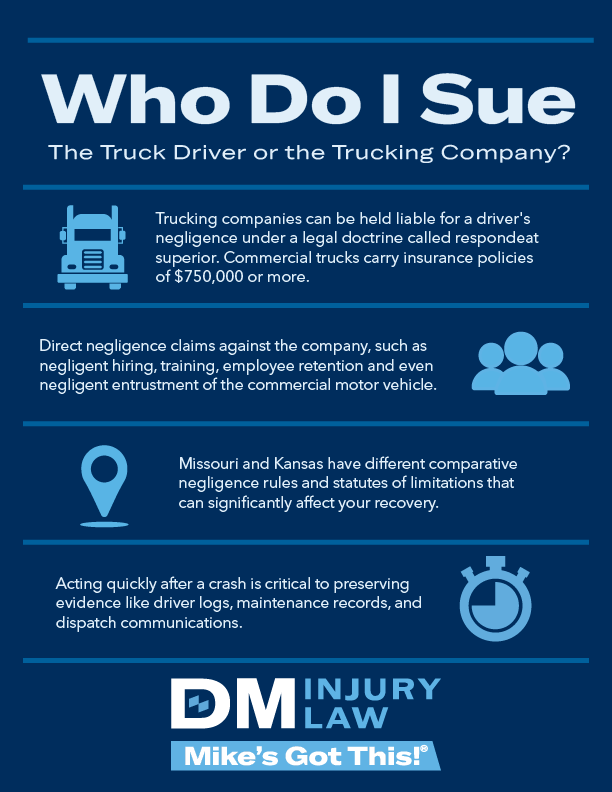
- Trucking companies can be held liable for a driver’s negligence under a legal doctrine called respondeat superior, even if the company itself did nothing wrong.
- Direct negligence claims against the company, such as negligent hiring or unrealistic scheduling, can unlock additional compensation and even punitive damages.
- Freight brokers and vehicle manufacturers may also share liability in a Kansas City truck accident.
- Missouri and Kansas have different comparative negligence rules and statutes of limitations that can significantly affect your recovery.
- Commercial trucks carry insurance policies of $750,000 or more, compared to Missouri’s minimum auto insurance of just $25,000 per person for bodily injury.
- Acting quickly after a crash is critical to preserving evidence like driver logs, maintenance records, and dispatch communications.
Why the Trucking Company Is Often the Real Target After a Semi-Truck Collision
When people think about a truck accident lawsuit, they picture suing the person behind the wheel. And you can do that. But here is the reality: most commercial truck drivers carry limited personal assets. Their individual insurance often is not enough to cover catastrophic injuries like traumatic brain injuries, spinal cord damage, or wrongful death.
The trucking company is a different story. The Federal Motor Carrier Safety Administration (FMCSA) requires commercial carriers to maintain significantly higher coverage:
- General Freight Trucks (over 10,001 lbs): At least $750,000 in liability insurance
- Hazardous Materials Carriers: Up to $5 million in liability insurance
- Compare That To: Missouri’s minimum auto insurance of just $25,000 per person for bodily injury
This is what attorneys mean when they talk about “deep pockets.” Suing a trucking company for negligence is not about being aggressive for the sake of it. It is about making sure that the compensation available actually matches the harm done.
A Missouri Verdict That Proved the Point
A Missouri jury demonstrated exactly this principle in 2024, when it returned a $462 million verdict against trailer manufacturer Wabash National Corporation after two young fathers were killed in an underride crash on Interstate 44/55 near St. Louis.
The jury found the company 65% responsible and awarded $450 million in punitive damages alone, based on evidence that the company had failed to build safer equipment for decades to save roughly $15 million per year. While the case was later reduced by the court, the original verdict sent a powerful message about corporate accountability in the trucking industry.
Respondeat Superior: Holding the Company Liable for the Driver
The most common legal path to suing a trucking company for negligence runs through a doctrine called respondeat superior. In plain English, this means “let the master answer.” If a truck driver was acting within the scope of their employment when the crash happened, the trucking company can be held legally responsible for the driver’s mistakes.
Here is what that looks like in practice. If a driver was hauling freight between distribution centers, following a route assigned by the company, and caused an accident, the company is on the hook, even if the company itself did nothing wrong. This applies whether the accident happened on I-70 heading through downtown Kansas City or on I-35 crossing from Missouri into Kansas.
What About the “Independent Contractor” Defense?
Trucking companies sometimes try to avoid this liability by claiming the driver was an independent contractor rather than an employee. However, both Missouri and Kansas courts look beyond the label on the contract. Judges examine the actual relationship by asking questions like:
- Who controlled the driver’s schedule and routes?
- Who owned or leased the truck?
- Did the company’s name or branding appear on the vehicle?
- How was the driver paid?
In the Missouri case Horner v. FedEx Ground Package System, a court found FedEx vicariously liable in part because it had provided identifying placards for the truck. Companies cannot simply relabel a relationship and walk away from responsibility.
A Key Legal Nuance in Missouri Law
There is an important wrinkle under the Missouri Supreme Court’s ruling in McHaffie v. Bunch. Once a trucking company admits that a driver was its employee acting within the scope of employment, the plaintiff generally must choose between respondeat superior and direct negligence theories.
The exception is when the injured person has a viable claim for punitive damages, which Missouri courts have consistently allowed alongside respondeat superior claims.
Direct Negligence: When the Company Itself Is at Fault After a Truck Accident
Respondeat superior is powerful, but direct truck accident negligence claims against the trucking company can be even more valuable. These claims go beyond holding the company responsible for the driver and instead focus on what the company itself did wrong. Common direct negligence claims in trucking cases include:
- Negligent Hiring: The company hired a driver with a history of safety violations, a suspended license, or substance abuse issues without conducting a proper background check.
- Inadequate Training: The company failed to train its drivers on safety procedures, federal regulations, or the specific demands of the routes they were assigned.
- Negligent Supervision: The company did not properly monitor its drivers’ compliance with safety rules, including hours-of-service limits.
- Unrealistic Scheduling: The company pressured drivers to meet delivery deadlines that required driving beyond safe or legal limits.
- Poor Maintenance: The company failed to properly inspect, maintain, or repair its trucks, leading to mechanical failures like brake problems or tire blowouts.
These claims matter because they can open the door to punitive damages, which are meant to punish particularly reckless behavior. When evidence shows that a trucking company knowingly put an unqualified driver on the road or pressured drivers to falsify their logbooks, juries in Missouri and Kansas have shown a willingness to hold those companies accountable in significant ways.
Pursuing direct negligence claims also requires evidence that can disappear quickly. The FMCSA requires trucking companies to maintain certain records, but some of those records can be disposed of after just six months.
Driver logs, electronic logging device (ELD) data, maintenance records, and dispatch communications are all time-sensitive. This is one of the reasons it is so important to talk to an attorney soon after a crash.
Comparative Negligence: Missouri vs. Kansas
Because Kansas City sits on the state line, understanding the comparative negligence rules in both Missouri and Kansas is critical for anyone suing a trucking company for negligence in this area.
- Missouri follows a pure comparative negligence system under Mo. Rev. Stat. § 537.765. This means that even if you are found partially at fault for the accident, your compensation is reduced by your percentage of fault, but you are never completely barred from recovery. If a jury finds you 30% at fault and the trucking company 70% at fault on $500,000 in damages, you would still recover $350,000.
- Kansas takes a stricter approach. Under K.S.A. § 60-258a, Kansas uses a modified comparative negligence system with a 50% bar. If you are found to be 50% or more at fault, you cannot recover anything. If your fault is less than 50%, your award is reduced proportionally. This is a significant difference that can affect which state’s law applies to your case, especially when the accident happens near the state line.
Trucking companies and their insurers are well aware of these differences. They will often try to shift as much blame as possible onto the injured person, arguing that the driver was speeding, not paying attention, or otherwise contributed to the crash.
Having a legal team that understands vicarious liability in Kansas City and the nuances of both states’ laws is essential to protecting your recovery.
Statutes of Limitations: How Long You Have to File a Truck Accident Claim
Another key difference between Missouri and Kansas involves how long you have to file a personal injury lawsuit after a truck accident.
- In Missouri, the statute of limitations for personal injury claims is five years from the date of injury under Mo. Rev. Stat. § 516.120. While that may seem like a generous window, critical evidence in trucking cases can disappear long before the deadline.
- In Kansas, the deadline is much shorter. Under K.S.A. § 60-513, you generally have just two years from the date of the accident to file a personal injury lawsuit.
Regardless of which state’s law applies to your case, the sooner you take action, the better. Trucking companies have legal teams that begin building their defense immediately after a crash. Evidence like electronic logging data, driver qualification files, drug and alcohol testing results, and vehicle maintenance records all need to be preserved quickly.
A formal spoliation letter, which legally requires the company to preserve evidence, should go out as soon as possible.
Protecting Your Rights After a Kansas City Truck Accident
Once you are home and safe after a truck accident, there are several steps you can take to protect your legal rights:
- Document Everything: Take photographs of your injuries, your vehicle, and any other property damage. Save all medical records, bills, and receipts related to your treatment.
- Request the Police Report: The official crash report will contain important details about the accident, including any citations issued and the officer’s initial observations.
- Be Cautious with Insurance Adjusters: The trucking company’s insurance carrier will likely reach out quickly. Their goal is to settle for as little as possible. Avoid giving recorded statements or accepting early offers before you understand the full extent of your injuries.
- Preserve Evidence: Write down everything you remember about the crash while it is still fresh. Note the name and company information from the truck, the location, weather conditions, and anything the driver or witnesses said.
- Talk to an Attorney Before the Deadline: Whether Missouri’s five-year or Kansas’s two-year statute of limitations applies, do not wait. The strongest cases are built with evidence gathered early.
Taking these steps helps build the foundation for holding the right parties accountable, whether that means suing the driver, the trucking company, a freight broker, or all of the above.
Suing a Trucking Company for Negligence FAQ
Here are some common questions Kansas City truck accident victims ask when considering their legal options.
What is the difference between vicarious liability and direct negligence in a trucking case?
Vicarious liability, through respondeat superior, holds the trucking company responsible for the driver’s actions during employment. Direct negligence focuses on the company’s own failures, like hiring an unqualified driver or ignoring maintenance requirements. Both can apply in the same case, though Missouri law sometimes requires choosing one theory over the other unless punitive damages are at stake.
How do I know if the truck driver was an employee or an independent contractor?
Courts look at the real-world relationship, not just the contract. Factors include who controlled the driver’s schedule and routes, who owned the truck, whether the company’s branding appeared on the vehicle, and how the driver was paid. An attorney can investigate these details through discovery and corporate records.
What is negligent hiring in a trucking case?
A negligent hiring claim argues that the trucking company failed to properly screen a driver before putting them on the road. This could mean the company skipped background checks, ignored a history of traffic violations, or failed to conduct required drug and alcohol testing under FMCSA regulations.
Can I sue a freight broker after a truck accident in Kansas City?
In some cases, yes. Freight brokers have a duty to vet the carriers they hire, including verifying safety ratings, insurance coverage, and inspection history through the FMCSA’s SAFER system. If a broker hired a carrier with a poor safety record to save on costs and that carrier caused your crash, the broker may be liable for negligent selection. Brokers typically carry higher insurance limits than small carriers, which can make a meaningful difference in your recovery.
Can I sue Amazon or FedEx if their driver hit me in Kansas City?
It depends on the relationship between the driver and the company. Large logistics companies use a mix of direct employees, independent contractors, and third-party delivery partners. If the driver was a direct employee acting within the scope of their job, the parent company may be liable under respondeat superior. If the driver worked for a contracted delivery service, liability depends on how much control the larger company exercised over routes, schedules, and performance standards. These cases require a careful look at the corporate structure and operational agreements involved.
Talk to Our Kansas City Truck Accident Attorneys Today
Truck accidents are more complex than typical car crashes. They involve federal regulations, multiple potentially liable parties, and well-funded corporate defense teams.
At DM Injury Law, we have roughly 70 attorneys and approximately 250 support staff members who work together to handle every aspect of our clients’ cases, from investigating the crash and preserving critical evidence to going toe-to-toe with trucking companies and their insurers.
We have recovered more than $900 million for clients in claims involving auto accidents, workplace injuries, serious injuries, and wrongful death. We take cases on a contingency fee basis, which means there is no cost to hire our team and no fee unless we recover compensation for you.
If you or someone you love was hurt in a truck accident in the Kansas City area, whether on the Missouri or Kansas side of the state line, we can discuss your rights and options during a free consultation.
Call (405) 295-0622 or contact us online today for a free consultation.
Past results do not guarantee future outcomes. Every case is different and must be evaluated on its own facts.