





For families who have lost loved ones due to another person’s carelessness, the statute of limitations for wrongful death claims in Colorado is generally two years from the date of the person’s death.
On top of grief, families of wrongful death victims are often left with mounting bills, unanswered questions about what happened, and a growing sense that something needs to be done.
A wrongful death lawsuit provides a path for the surviving family to seek justice and compensation. But there are strict guidelines that must be followed, including the statute of limitations Colorado law imposes.
Two years may sound like enough time, but the clock starts ticking immediately, and building a strong case takes longer than many people expect.
Call (405) 295-0622 or contact us online today for a free consultation.
Key Takeaways about the Statute of Limitations for Wrongful Death in Colorado
- Colorado’s general statute of limitations for wrongful death is two years from the date of death.
- A four-year deadline applies in cases involving vehicular homicide combined with leaving the scene.
- Certain exceptions, including the discovery rule and tolling for minors, can change the filing window.
- Claims against a government entity require written notice within 182 days of the loss.
- Recent changes to Colorado law have significantly increased the damages cap in wrongful death cases.
- Only specific family members may file, and eligibility shifts during the first and second year after a death.
Understanding the Statute of Limitations for Wrongful Death in Colorado
A statute of limitations is simply a legal deadline. It sets a firm window of time for filing a lawsuit. In Colorado, the statute of limitations wrongful death rule means that eligible family members generally have two years from the date their loved one passed away to file a civil claim in court. This deadline is set by Colo. Rev. Stat. § 13-80-102(1)(d).
It is important to understand that the two-year clock starts on the date of death, not the date of the accident or incident that caused the injury. For example, if someone is seriously hurt in a crash along I-25 near downtown Denver and passes away several months later from complications, the filing deadline begins on the day they died.
If a lawsuit is not filed before that two-year window closes, a court will almost certainly dismiss the case. It does not matter how strong the evidence is or how clear the other party’s fault may be. Missing the deadline typically means losing the right to seek any compensation at all.
Exceptions to the Two-Year Filing Deadline
While two years is the general rule, Colorado law does recognize certain situations where the timeline can be extended. Understanding these exceptions to the filing deadline for death cases can make a real difference for families who may be worried that their time is running out.
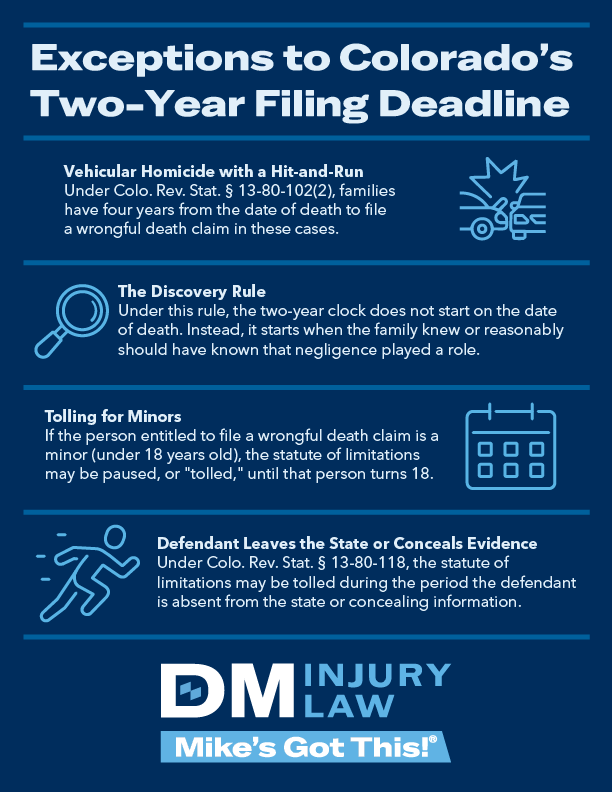
- Vehicular Homicide with a Hit-and-Run
Under Colo. Rev. Stat. § 13-80-102(2), families have four years from the date of death to file a wrongful death claim in these cases. This extended deadline recognizes that identifying a driver who fled the scene can take additional time and investigation.
- The Discovery Rule
Under this rule, the two-year clock does not start on the date of death. Instead, it starts when the family knew or reasonably should have known that negligence played a role.
This exception is evaluated on a case-by-case basis and tends to come up in situations like delayed medical diagnoses or toxic exposure, where the connection between another party’s actions and the death is not obvious right away.
- Tolling for Minors
If the person entitled to file a wrongful death claim is a minor (under 18 years old), the statute of limitations may be paused, or “tolled,” until that person turns 18. Once the child reaches adulthood, the standard filing period begins.
- Defendant Leaves the State or Conceals Evidence
Under Colo. Rev. Stat. § 13-80-118, the statute of limitations may be tolled during the period the defendant is absent from the state or concealing information. This prevents someone from running out the clock by simply disappearing.
These exceptions show that while the 2-year limit for wrongful death is the standard, every family’s situation is different. Talking with a Denver wrongful death attorney early can help clarify which deadline applies.
The Shorter Deadline for Government Claims
One situation that catches many families off guard involves deaths caused by the negligence of a government employee or entity. Think of a fatal crash involving a city-owned vehicle, an accident on a poorly maintained state highway, or a death at a public facility.
Under the Colorado Governmental Immunity Act (CGIA), Colo. Rev. Stat. § 24-10-109, families must file a written notice of claim within 182 days of the loss. That is roughly six months, which is far less than the standard two-year deadline.
Failing to submit this written notice on time can permanently bar the wrongful death claim, regardless of how much time remains on the general statute of limitations.
The notice must include specific details about the incident and the injuries or death. For wrongful death claims, the notice can be filed by the personal representative of the estate, the surviving spouse, or the next of kin. Because this deadline is so much shorter than most people expect, it is one of the biggest reasons to reach out to a legal team as soon as possible.
Who Can File a Wrongful Death Claim in Colorado
Colorado’s Wrongful Death Act, outlined in Colo. Rev. Stat. § 13-21-201, does not allow just anyone to file a claim. The law spells out a specific order of priority, and eligibility shifts depending on how much time has passed since the death.
During the first year after a death, a claim may be filed by:
- The surviving spouse
- If there is no spouse, the deceased’s children or a designated beneficiary
During the second year after a death, additional parties may file, including:
- Surviving children (if they did not file in year one)
- Parents, if there are no surviving children
As of January 1, 2025, House Bill 24-1472 expanded eligibility to include siblings and heirs of siblings in certain situations, such as when the deceased had no surviving spouse, children, or parents. If one eligible family member files a claim, other qualifying relatives generally have 90 days to join.
This structured system is designed to protect the people who depended on the deceased the most. But it also means that timing matters on two levels: families must file within the statute of limitations and must pay attention to which year they are in to know who is eligible to bring the case forward.
What Compensation Is Available in a Denver Wrongful Death Case
Wrongful death claims in Colorado can seek both economic and non-economic damages. Understanding what is recoverable helps families see the full picture of what a case may involve.
Economic damages may include:
- Medical bills related to the deceased’s final injury or illness
- Funeral and burial costs
- Loss of the deceased’s expected future income and benefits
- Loss of financial support provided to the household
Non-economic damages may include:
- Grief and emotional distress experienced by surviving family members
- Loss of companionship, guidance, and support
- Loss of consortium for a surviving spouse
For wrongful death lawsuits filed on or after January 1, 2025, Colorado’s cap on non-economic damages increased significantly to $2.125 million. This change, introduced by House Bill 24-1472, replaced the previous cap.
If the death resulted from a felonious killing, such as a DUI-related fatality, there is no cap at all. These caps are scheduled to adjust for inflation every two years starting in 2028.
Families may also seek punitive damages in certain cases where the at-fault party’s behavior was willful or reckless. These awards are intended to hold wrongdoers accountable beyond standard compensation.
Why Acting Quickly Matters
Even with a two-year window, waiting to pursue a wrongful death claim can hurt a family’s case in several ways.
- Evidence fades over time. Surveillance footage gets deleted. Witnesses’ memories become less reliable. Physical evidence from the scene of an accident may be cleaned up or altered. The sooner an investigation begins, the stronger the evidence will be.
- Insurance companies move fast. The company or individual responsible for the death will likely have an insurance team working on their side right away. Those adjusters are trained to protect profits, not people. Having legal representation early helps level the playing field.
- The legal process takes time. Building a wrongful death case may require working with accident reconstruction professionals, financial consultants, and medical reviewers. All of this takes time. Starting early gives a personal injury attorney the time needed to build the strongest possible case before the deadline arrives.
For Denver families, this sense of urgency is real. Whether the loss happened on a busy stretch of Colorado Boulevard, in a workplace along the Front Range, or in a hospital setting, the clock is already running.
How Colorado’s Comparative Fault Rules May Affect a Claim
Colorado follows a modified comparative fault system under Colo. Rev. Stat. § 13-21-111. This means that if the deceased was partially at fault for the incident that led to their death, it can affect the amount of compensation the family receives.
Under this rule, a family’s recovery is reduced by the percentage of fault attributed to the deceased. However, if the deceased is found to be 50% or more at fault, the family is barred from recovering any wrongful death damages at all.
Insurance companies will often try to shift blame onto the deceased person to reduce or eliminate what they have to pay. An experienced legal team can push back against those tactics and fight for a fair outcome.
FAQs for Statute of Limitations for Wrongful Death in Colorado
Here are answers to some of the most common questions families in Denver have about wrongful death filing deadlines.
Is it too late to sue for my husband’s death in Denver?
It depends on when your husband passed away and the circumstances surrounding his death. If his death occurred within the last two years, you likely still have time to file a claim.
Certain exceptions, like the discovery rule or the extended deadline for hit-and-run vehicular homicide cases, may also apply. The best step is to speak with an attorney who can evaluate your specific timeline.
Does the two-year deadline start from the date of the accident or the date of death?
The statute of limitations begins on the date of death, not the date of the accident. If someone is injured and passes away weeks or months later due to complications from that injury, the clock starts when they die.
Can I file a wrongful death claim if my loved one died more than two years ago?
In most cases, no. Colorado courts are strict about enforcing the two-year deadline. However, limited exceptions may apply, such as the discovery rule if you only recently learned that negligence played a role. An attorney can help determine whether an exception may be available.
What happens if a government employee caused my family member’s death?
You face a much shorter deadline. Under the Colorado Governmental Immunity Act, you must file a written notice of claim within 182 days of the loss. Missing this notice requirement can permanently prevent you from pursuing the case, even if you are still within the standard two-year period.
What is the tolling statute, and could it apply to my case?
Tolling means the statute of limitations is paused for a period of time. In Colorado, tolling may apply if the person eligible to file the claim is a minor, if the defendant leaves the state, or if evidence was deliberately concealed. Tolling does not apply in every situation, so it is important to discuss the specific facts of your case with an attorney.
Is there a statute of repose for wrongful death claims in Colorado?
Colorado does not have a separate statute of repose that applies to wrongful death claims in general. However, if the wrongful death arose from medical malpractice, a statute of repose may come into play.
Under Colo. Rev. Stat. § 13-80-102.5, no medical malpractice lawsuit can be filed more than three years after the act of malpractice occurred, even if the injury or death was not discovered until later. Statutes of repose may also apply in cases involving defective products or construction defects.
Unlike a statute of limitations, a statute of repose cannot be paused or tolled, making it an absolute outer deadline. If your loved one’s death may be connected to medical care or a defective product, speaking with an attorney quickly is especially important.
Contact DM Injury Law for a Free Wrongful Death Consultation
No amount of compensation can undo the loss of someone you love. But holding the responsible party accountable and securing financial stability for your family is something worth fighting for.
At DM Injury Law, we have a team of attorneys and support staff ready to help Denver families through every step of a wrongful death claim. We represent families across the region with the resources and dedication these cases demand. We work on a contingency fee basis, which means there is no cost to hire our team and no fee unless a recovery is made in your case.
If you have lost a loved one and are unsure about your legal options or your filing deadline, we can help you understand where you stand during a free consultation.
Past results do not guarantee future outcomes. Every case is different and must be evaluated on its own facts.
Call (405) 295-0622 or contact us online today for a free consultation.