




Drunk driving crashes cause severe, immediate harm. Choosing to drink and drive creates serious risks for everyone on the road, and the drunk driver isn’t always the only party that bears legal responsibility.
Missouri law recognizes that bars, restaurants, and other establishments serving alcohol have a duty to the public. When these businesses continue pouring drinks for someone who’s clearly intoxicated, they contribute to the danger that person poses behind the wheel. Under Missouri’s dram shop law, injured victims may seek compensation from both the impaired driver and the establishment that overserved them.
Call (314) 300-0314 or contact us online today for a free consultation.
Key Takeaways for Missouri Dram Shop Law
- Missouri’s dram shop statute holds commercial establishments legally responsible when they knowingly serve visibly intoxicated patrons who subsequently cause injuries to others.
- To establish liability, you must prove: (1) a licensed, on-premises sale; (2) the patron was visibly intoxicated; (3) the seller knowingly continued service; and (4) that service proximately caused the injury.
- Social hosts at private parties generally face no liability under Missouri law, which targets only commercial alcohol establishments like bars, restaurants, and nightclubs.
- Proving visible intoxication requires substantial evidence, including witness testimony, surveillance footage, expert analysis, and documentation showing observable signs of impairment were present when service continued.
- Dram shop claims function separately from drunk driver lawsuits and access different insurance coverage, offering injured victims additional avenues for compensation when the driver’s policy proves insufficient.
What Is Missouri’s Dram Shop Law?
The term “dram shop” comes from 18th-century establishments that sold alcohol by the “dram,” a small unit of measurement. Today, dram shop laws regulate the liability of commercial establishments that serve alcohol to patrons who later cause harm.
Missouri’s dram shop statute, RSMo § 537.053, creates a specific legal framework for holding alcohol-serving businesses accountable. The law balances public safety concerns against the hospitality industry’s commercial interests by establishing clear standards that must be met before liability attaches.
The statute advances public safety. It incentivizes bars, restaurants, and similar establishments to monitor patron behavior, train staff to recognize intoxication, and refuse service when appropriate.
Who the Law Applies To
The statute applies to licensed commercial sellers of alcohol. This includes bars, taverns, restaurants, nightclubs, sports bars, and similar venues where alcoholic beverages are served to patrons for profit.
A commercial sale is required; providing alcohol without a sale does not create liability. This commercial element distinguishes dram shop liability from other forms of alcohol-related legal responsibility.
Retail liquor stores or off-premises alcohol sales are not covered under Missouri’s dram shop law.
Who the Law Does NOT Apply To
The statute does not impose civil liability on social hosts; it applies to sellers licensed to serve by the drink for on-premises consumption. Social hosts may face criminal liability in some scenarios, but civil liability under dram shop law is limited to commercial sellers. Furnishing alcohol to minors is addressed elsewhere in criminal law, not as a civil social-host claim.
If someone hosts a gathering at their home and a guest becomes intoxicated and causes an accident, the host generally faces no legal responsibility under this statute.
Employers hosting work parties typically aren’t subject to dram shop liability unless they hold a commercial liquor license for the event.
The Four Essential Elements of a Missouri Dram Shop Claim
Successfully pursuing compensation under Missouri’s dram shop law requires proving four distinct legal elements. Each component must be established with credible evidence for the claim to succeed.
Sale of Intoxicating Liquor
The first element requires showing that the establishment sold or served alcoholic beverages to the patron. Commercial transactions leave evidence trails like credit card receipts, bar tabs, and point-of-sale records.
Witness testimony from other patrons, servers, or bartenders may confirm service. Surveillance footage from inside the establishment can visually document drink orders and service patterns.
Knowingly Served
Actual knowledge is required to prove the seller knowingly served a visibly intoxicated person; for serving minors, the standard includes “knew or should have known.”
The threshold is whether the establishment actually knew the patron was visibly intoxicated when served.
Several factors inform this analysis. Staff members trained to recognize intoxication through responsible beverage service certifications have a higher duty to observe patron behavior. When servers express concerns to managers who override those concerns and authorize continued service, knowledge clearly exists. Prior interactions earlier in the evening showing intoxication also establish knowledge.
Evidence establishing knowledge might include server testimony acknowledging they noticed the patron’s condition, incident reports documenting patron behavior, or testimony from other customers who observed obvious intoxication that staff must have seen.
Visibly Intoxicated Person
Visible intoxication forms the core of Missouri dram shop liability. The law doesn’t impose liability for serving someone who’s merely consumed alcohol—the patron must display observable signs of impairment that would be apparent to a reasonable observer.
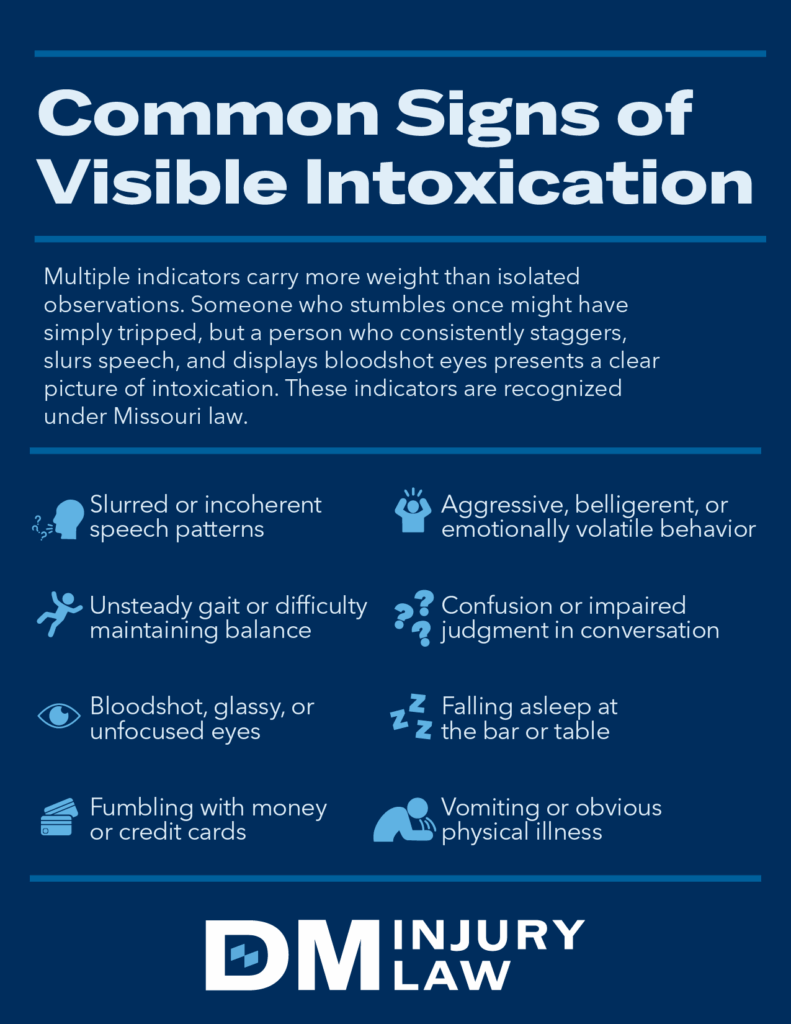
Courts focus on outward signs rather than blood alcohol concentration (BAC). By statute, “visibly intoxicated” means impairment shown by significantly uncoordinated physical action or significant physical dysfunction; BAC alone is not prima facie proof (though it may be relevant). Missouri courts require corroborating evidence from medical evaluations, eyewitness accounts, and often video to establish visible intoxication under the statute. Common signs of visible intoxication recognized under Missouri law include:
- Slurred or incoherent speech patterns
- Unsteady gait or difficulty maintaining balance
- Bloodshot, glassy, or unfocused eyes
- Fumbling with money or credit cards
- Aggressive, belligerent, or emotionally volatile behavior
- Confusion or impaired judgment in conversation
- Falling asleep at the bar or table
- Vomiting or obvious physical illness
Multiple indicators carry more weight than isolated observations. Someone who stumbles once might have simply tripped, but a person who consistently staggers, slurs speech, and displays bloodshot eyes presents a clear picture of intoxication.
The visible intoxication must exist at the time of service. If a patron appeared sober when served but became visibly intoxicated later from cumulative alcohol effects, liability depends on whether continued service occurred after impairment became observable.
Proximate Cause
You must show that the service proximately caused the patron’s intoxication and that intoxication proximately caused the crash and injuries.
Temporal proximity strengthens causation claims. When limited time passes between the individual leaving the establishment and causing an accident, with no opportunity for intervening alcohol consumption, causation becomes clearer.
Expert testimony from toxicologists often proves essential for establishing causation. These specialists can analyze BAC levels at the time of the accident, work backward to estimate consumption amounts and timing, and offer opinions about whether the establishment’s service contributed substantially to the patron’s intoxication level.
Evidence Needed to Prove a Dram Shop Case
Successful claims require evidence for each element. Unlike straightforward drunk driving cases where police reports and BAC tests establish liability, dram shop claims require an extensive investigation into what occurred inside the establishment before the accident.
Documenting Visible Intoxication
Surveillance video from inside the establishment offers powerful evidence. Footage showing a patron stumbling, struggling to walk, or displaying other obvious impairment signs makes the intoxication visible to everyone, including jurors evaluating the case later. Surveillance footage is often deleted within 30 to 90 days, requiring prompt action after an incident to preserve key video evidence.
Witness testimony provides firsthand accounts of the patron’s condition. Other customers sitting nearby, establishment security staff, and even the servers themselves may testify about observable intoxication signs.
Police observations shortly after the patron left the establishment document intoxication levels. If law enforcement encountered the patron within minutes of their departure and noted extreme intoxication, those observations suggest the condition existed when they were still being served.
Establishing the Establishment’s Knowledge
Internal incident reports create contemporaneous documentation. If security staff documented the patron’s disruptive behavior or if managers noted concerns about the customer, these records prove actual knowledge existed.
Training records demonstrate what staff members were taught to recognize. Responsible beverage service certifications establish that employees received instruction in identifying intoxication, raising the standard of care they must exercise.
Other patron testimony about interactions with staff proves knowledge. If witnesses heard servers discussing concerns about the patron’s intoxication, this demonstrates actual awareness.
Proving Causation
Toxicology experts can work backward from post-accident BAC levels to estimate consumption amounts and create timelines showing when and where alcohol was consumed.
Key Causation Proof:
- Toxicology back-calculation from BAC levels at the time of the accident to estimate consumption amounts and timing at the establishment
- Credit card receipts and bar tabs documenting exactly what was purchased, when service occurred, and in what amounts with precise timestamps
- Point-to-point timeline showing minimal opportunity for intervening alcohol consumption between establishments
- Direct-from-bar to crash timing evidence demonstrating the patron drove immediately from the establishment to the accident scene within minutes
Common Defense Strategies Establishments Use
Establishments typically mount vigorous defenses backed by liquor liability insurers.
Appearance/Observation Defenses
- The patron didn’t appear intoxicated when served, despite actual intoxication levels
- Poor lighting conditions prevented clear observation of intoxication signs
- Crowded conditions made it impossible to monitor individual patron behavior closely
- The patron effectively masked their impairment level
Multiple-Location Defenses
- The patron visited other bars earlier in the evening before arriving at the defendant establishment
- The patron consumed alcohol after leaving the defendant establishment
- Their service wasn’t the proximate cause of the intoxication level that caused the accident
- Other establishments bear primary responsibility for the patron’s intoxication
Time-Gap Defenses
- Significant time elapsed between the patron leaving and causing the accident
- The longer interval creates more opportunity for intervening causes, like additional consumption elsewhere
- Metabolization of earlier drinks reduces the establishment’s causal contribution
- The patron’s actions after leaving broke the chain of causation
How Dram Shop Claims Differ From Drunk Driver Claims
Pursuing compensation from the establishment rather than just the drunk driver involves distinct legal theories, different insurance coverage, and separate litigation processes.
Different Defendants, Different Insurance
Drunk driver claims target the impaired individual and access their auto insurance policy. In Missouri, minimum auto liability coverage is $25,000 per person for bodily injury, which is often insufficient in serious cases. (See Missouri DOR minimums.)
Dram shop claims target commercial establishments and access liquor liability insurance policies. Liquor liability policies often provide $1–2 million or more in coverage. For victims facing catastrophic injuries with medical bills, lost wages, and other damages exceeding the drunk driver’s minimal coverage, the establishment’s deeper insurance coverage may provide the only realistic path to fair compensation.
Independent Legal Theories
Victims may pursue both claims simultaneously. Success against the drunk driver doesn’t preclude a dram shop claim, and vice versa. Different evidence matters for each claim, and settlement negotiations proceed independently.
Missouri vs. Illinois: Understanding Metro Area Differences
The St. Louis metropolitan area spans Missouri and Illinois, creating situations where Missouri residents may be injured by drunk drivers who were overserved at Illinois establishments, or vice versa.
Illinois has its own Dramshop Act (235 ILCS 5/6-21) with somewhat different standards. While both states impose commercial establishment liability for overservice, Illinois law may apply broader “intoxication” standards rather than requiring “visible” intoxication specifically.
Choice of law questions arise when accidents involve cross-border elements. Where the accident occurred, where the overservice happened, and other factors influence which state’s law applies.
Statute of Limitations and Timing Considerations
Missouri law imposes strict deadlines for filing dram shop claims. Personal injury claims generally must be filed within five years, while wrongful death claims carry a three-year limit.
Personal injury claims generally must be filed within two years in Illinois, which includes dram shop actions, though the Illinois Dramshop Act itself specifies a one-year limit for injury or property damage claims against the dram shop, and a two-year limit for loss of means of support claims.
Early investigation is critical for practical reasons beyond filing deadlines.
Why Speed Matters
- Surveillance video from inside establishments typically gets deleted or recorded over within 30 to 90 days
- Witnesses’ memories fade rapidly as time passes from the incident
- Staff members change jobs and become difficult to locate for testimony
The Complexity of Dram Shop Cases
Dram shop cases present distinct challenges that require thorough investigation and experienced representation.
The evidence exists primarily in the defendant’s control. The establishment possesses surveillance footage, has access to staff members, and controls internal records. Obtaining this evidence requires formal legal processes, including subpoenas and discovery requests.
Establishments typically defend these claims aggressively. Liquor liability insurers understand the stakes and invest substantial resources in defending their insureds. They hire experienced attorneys, retain expert witnesses, and employ sophisticated strategies to defeat claims.
FAQ for Missouri Dram Shop Law
Can I sue both the drunk driver and the bar that served them?
Yes. These claims proceed independently under different legal theories. You may pursue compensation from the drunk driver’s auto insurance while simultaneously investigating and pursuing a dram shop claim against the establishment. Success or settlement with one defendant doesn’t affect your rights against the other.
What if the drunk driver was drinking at multiple bars before the accident?
Multiple establishments might share liability if each knowingly served a visibly intoxicated patron. Your attorney would investigate each location, gather evidence about service at each establishment, and potentially pursue claims against multiple defendants. Missouri applies comparative fault principles, allocating responsibility among all parties who contributed to the harm.
Does the establishment have to be a bar, or do restaurants face dram shop liability too?
Any commercial establishment serving alcohol may face liability under Missouri’s dram shop law. This includes restaurants, nightclubs, sports bars, taverns, country clubs, and any other establishments that sell alcohol to patrons. The key factor is commercial service, not the establishment’s primary business purpose.
What if I can’t prove exactly how many drinks were served or obtain surveillance video?
While video evidence strengthens claims significantly, cases can succeed without it. Witness testimony, credit card receipts, expert analysis of BAC levels, police observations, and circumstantial evidence may establish overservice. Your attorney can build a strong case using multiple evidence sources even when some ideal proof isn’t available.
Getting Legal Help for Dram Shop Claims
If you suffered injuries in an accident caused by a drunk driver who was overserved at a St. Louis area bar or restaurant, understanding Missouri’s dram shop law opens potential pathways to fair compensation beyond the driver’s limited insurance.
At DM Injury Law, our experienced team has recovered over $900 million for injury victims across Missouri, Kansas, Oklahoma, and Colorado. We investigate thoroughly, gather compelling evidence, and fight aggressively to hold all responsible parties accountable—whether that means pursuing the drunk driver, the establishment that overserved them, or both.
Your recovery is our priority. We handle cases on contingency; you owe no fee unless we recover for you.
Call (314) 300-0314 or contact us online today for a free consultation. Our team is available 24/7 to discuss your case and explain your legal options.
Past results do not guarantee future outcomes. Every case is different and must be evaluated on its own facts.
Call (314) 300-0314 or contact us online today for a free consultation.