





While the 2024 law makes it legal for qualified riders over 21 to ride without a helmet, it does not stop an at-fault driver’s insurance company from arguing you are partially to blame for your own injuries.
This is the core of the problem: a perfectly legal choice could be misinterpreted and used against you during settlement talks. Insurance adjusters will typically bring up a legal concept called comparative negligence to reduce the amount they have to pay for your head, neck, or brain injuries. They may claim that your decision not to wear a helmet, even though allowed by law, demonstrates a failure to mitigate your potential damages.
But this is not a closed case. It is entirely possible to get the full and fair compensation you are owed after a crash. This involves building a strong case that proves the other driver’s negligence was the primary cause of the accident. It may also involve showing, through biomechanical analysis, that a helmet would not have prevented the specific type of injury you sustained.
If you have questions about how Nebraska’s updated helmet laws affect your specific crash claim, call DM Injury Law for a free consultation. Our initial consultation is always free, and there is no obligation to work with us. Our motorcycle accident lawyers understand the laws and can help you weigh your options.
Key Takeaways for Nebraska’s Motorcycle Helmet Law and Your
- Your legal compliance with LB1004 is crucial. Meeting the age, license, and safety course requirements is the first step to defending your claim; failing to meet them makes it much easier for insurers to assign you a higher percentage of fault.
- The type of injury you sustained matters. If your injuries were to your body (like a broken leg or spinal cord injury), we can argue that a helmet is irrelevant and fight to exclude that information from your case.
The Shift in Nebraska Law: LB1004 and the Repeal
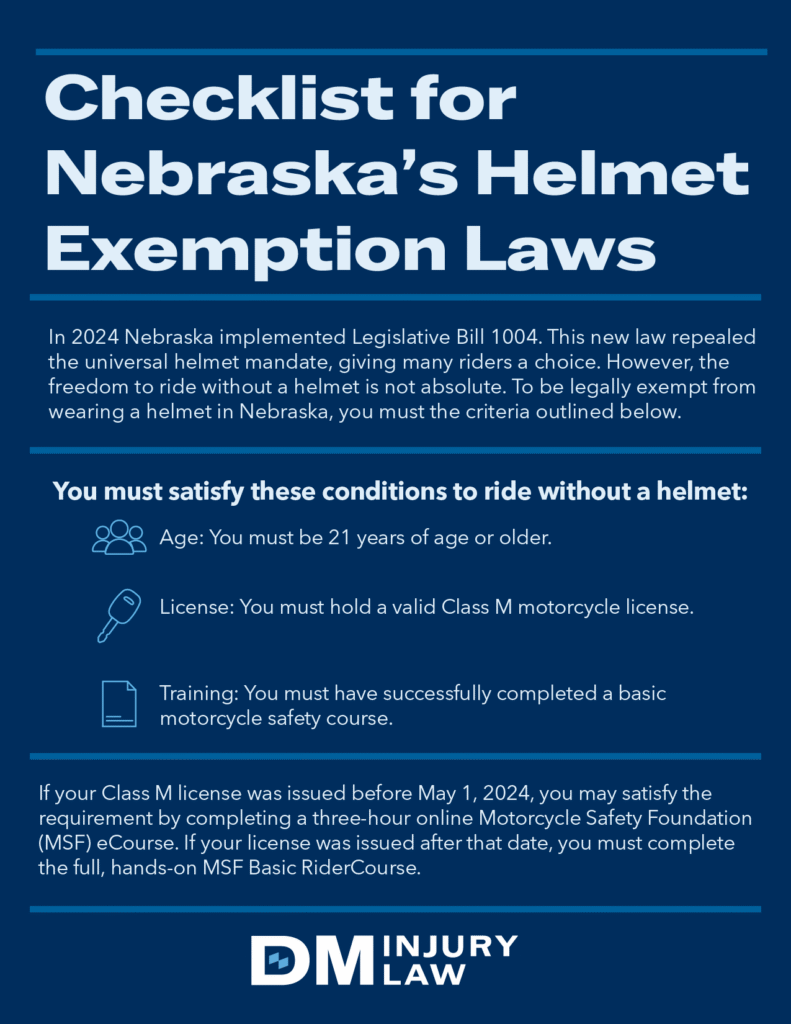
For decades, Nebraska had what was known as a universal helmet law. From 1989 until the end of 2023, every single person operating or riding a motorcycle was required to wear a helmet, no exceptions. That all changed at the start of 2024 with the implementation of Legislative Bill 1004.
This new law repealed the universal mandate, giving many riders a choice. However, the freedom to ride without a helmet is not absolute. To be legally exempt from wearing a helmet in Nebraska, you must meet a specific set of criteria outlined in Neb. Rev. Stat. § 60-6,279.
The Checklist for Helmet Exemption
You must satisfy every one of these conditions to ride without a helmet:
- Age: You must be 21 years of age or older.
- License: You must hold a valid Class M motorcycle license.
- Training: You must have successfully completed a basic motorcycle safety course.
The law also creates a distinction for the training requirement based on when your license was issued. If your Class M license was issued before May 1, 2024, you may satisfy the requirement by completing a three-hour online Motorcycle Safety Foundation (MSF) eCourse.
If your license was issued after that date, you must complete the full, hands-on MSF Basic RiderCourse. This rule applies uniformly across the state, whether you’re riding through downtown Omaha or across the Sandhills.
The Helmet Defense: How Insurers Weaponize Your Choice
Shortly after your crash, you will likely speak with an insurance adjuster for the at-fault driver. If you suffered a head or neck injury and weren’t wearing a helmet, you may hear them use a line of reasoning called the helmet defense.
The argument goes like this: even if their driver ran a red light and T-boned you, your decision not to wear a helmet made your injuries worse than they should have been. Therefore, they shouldn’t be responsible for the full extent of your medical bills and other damages. It’s a way for their business to manage its financial risk by shifting blame back onto you, the injured rider.
Using Statistics and Bias as Leverage
To support this argument, adjusters lean on a few key tactics. They typically quote statistics from the National Highway Traffic Safety Administration (NHTSA), such as the fact that helmets reduce the risk of head injury by 69%. This is part of a strategy to reduce your settlement offer by arguing you failed to mitigate damages, which is a legal term that suggests you didn’t take reasonable steps to protect yourself.
Insurers also understand that a potential jury might already be biased against you. A national survey found that 81% of the public supports universal helmet laws, suggesting that many Nebraskans may believe riding without one is inherently unsafe, regardless of what the new statute says. The insurance company uses this potential bias as leverage, hoping you will get nervous about going to court and accept a lower settlement offer now.
Their entire strategy rests on blurring the lines between what caused the crash and what contributed to the severity of your injury. Countering this requires a legal strategy focused on separating those two issues completely.
How Nebraska’s Updated Helmet Laws Affect Your Injury Settlement Through Comparative Negligence
When an insurance company argues that your lack of a helmet contributed to your injuries, they are invoking a legal principle known as comparative negligence.
Nebraska operates under a system of Modified Comparative Fault, which is defined in Neb. Rev. Stat. § 25-21,185.09. Simply put, this law directs a court or jury to assign a percentage of fault to everyone involved in an accident. The amount of compensation you may recover is then reduced by your percentage of fault.
The 50% Rule and Your Payout
This system has a strict cut-off point:
- If you are found to be 49% or less at fault: You may recover damages, but your total award will be reduced by your share of blame.
- If you are found to be 50% or more at fault: You are barred from recovering any money at all.
The legal arguments used to assign that percentage of fault differ depending on whether you were compliant with LB1004.
- If you were exempt and legally helmetless: The defense cannot argue negligence per se, which is negligence that results from violating a statute. Instead, they must argue that a “reasonable person” would have worn a helmet in that situation, which is a much higher bar for them to clear.
- If you were not exempt (under 21 or didn’t take the course): The defense has a much stronger case. They will argue negligence per se, claiming your direct violation of the helmet law contributed to your harm. This makes it far more likely that a jury will assign a higher percentage of fault to you.
Key Scenarios That Define Your Settlement Value
Scenario 1: You Were a Legal Helmetless Rider
You met all the requirements of LB1004: you are over 21, have your Class M license, and completed the required safety course. In this case, your negotiating position is much stronger. We would argue that you were exercising a legal right granted to you by the Nebraska Legislature. The conversation should not be about your lawful choice but about the other driver’s unlawful actions, such as their speeding, their illegal turn, or their distracted driving.
Scenario 2: You Were a Non-Compliant Rider
Perhaps you were under 21, or you were over 21 but had not yet completed the MSF course when the crash happened. This situation presents a higher risk of your settlement being significantly reduced. The insurance company will point to your non-compliance as clear evidence of negligence.
Here, the strategy must pivot to causation. We would argue that the absence of a helmet is irrelevant if the injury would have occurred anyway. For example, if you suffered a crushed pelvis, a severe spinal cord injury, or a broken leg, a helmet would have offered no protection. In these cases, we would file a motion to prevent the defense from even mentioning your helmet status to the jury, as it is not relevant to the injuries you sustained.
Scenario 3: You Were a Passenger
The law for passengers is specific. A passenger who is 21 or older is only exempt from wearing a helmet if the motorcycle operator is also fully exempt and compliant with the law. This creates a trap—if you were a passenger without a helmet, believing the driver was certified when they were not, an insurance company may treat you as negligent for not verifying their status.
This makes a settlement more difficult, as passengers usually have the right to file claims against both the other driver who caused the crash and the operator of the motorcycle they were on.
Scenario 4: The Eye Protection Loophole
There is one part of the law that remains universal: all riders and passengers must wear eye protection unless the motorcycle is equipped with a windshield. Unlike the helmet rule, this has no age or training exemption under Neb. Rev. Stat. § 60-6,279. If a bug, rock, or road debris struck your eye and caused you to lose control and crash, an insurer will argue the entire accident was your fault for violating the eye protection statute.
Building the Case: Evidence We Use to Protect Your Rights
At DM Injury Law, we gather the specific facts needed to counter the helmet defense and demonstrate what really happened.
This includes:
- DMV and MSF Record Verification: We subpoena official records from the Nebraska DMV and the Motorcycle Safety Foundation to provide documented proof that you met all legal requirements to ride without a helmet. This immediately strengthens your position.
- Biomechanical Analysis: In cases involving serious head injuries, we may work with biomechanical professionals. They analyze the physics of the crash, such as the speeds, angles, and forces involved, to determine if a standard, DOT-approved helmet would have actually prevented the specific Traumatic Brain Injury (TBI) you suffered. If the impact forces were too great, the helmet becomes a non-issue.
- Accident Reconstruction: We use dash cam footage, surveillance video, and expert analysis to reconstruct the accident. If we prove the other driver’s conduct was particularly reckless, such as driving drunk or texting, a jury is far more likely to focus on their egregious behavior instead of your choice of safety gear.
A Note for Out-of-State Riders
Nebraska’s major highways, particularly I-80, are popular routes for cross-country motorcyclists. If you are an out-of-state rider injured in a crash here, you need to be aware of how our laws might apply to your case. Even if your home state has no helmet or training requirements, a Nebraska court will likely apply Nebraska’s comparative negligence standards to your injury claim.
This might create a problem. If, for instance, your home state does not require a safety course but Nebraska law does for helmetless riding, the other driver’s insurance company may try to classify you as a non-compliant rider. They will argue that, while in Nebraska, you were subject to Nebraska’s rules. This can put visiting riders at a disadvantage, and it’s a legal nuance we are prepared to address.
Frequently Asked Questions About Nebraska Motorcycle Helmet Settlements
Can I still sue if I wasn’t wearing a helmet during the crash?
Yes. Your right to pursue compensation is based on who caused the accident. The at-fault party is still liable for their negligence. However, the amount of compensation you receive may be disputed if it’s argued that not wearing a helmet contributed to your specific injuries.
Does the insurance company know if I took the motorcycle safety course?
Not automatically. It is not their job to investigate your qualifications. It is our job to proactively provide proof of your MSF Basic RiderCourse completion directly to the adjuster. This establishes that you were operating within the bounds of the law and shuts down a potential line of attack.
What if I was wearing a novelty helmet instead of a DOT helmet?
For the purposes of an injury settlement, wearing a non-DOT-compliant novelty helmet is usually treated the same as wearing no helmet at all. An insurance company will argue that the equipment was insufficient to mitigate damages and did not meet the standards required by federal and state law.
I wasn’t wearing a helmet, but my injury is a broken leg. Does it matter?
It shouldn’t, but you should expect the insurance company to try and make it matter. We would immediately file a motion in court to exclude any evidence related to helmet non-use, arguing that it is legally irrelevant to an injury to your leg, back, or any other part of your body a helmet isn’t designed to protect.
How does the new law affect passengers under 21?
The law is very clear: any passenger under the age of 21 must wear a helmet at all times. There are no exceptions. A failure to do so is a direct violation of the statute, which will heavily impact that passenger’s ability to recover full compensation for a head injury.
Don’t Let an Insurance Company Dictate Your Fault
You do not forfeit your legal rights simply because you chose to exercise the option granted to you under LB1004. The freedom to ride without a helmet is now part of Nebraska law, and that choice should not be used to unfairly deny you the compensation needed to put your life back together.
An insurance adjuster is trained to use the helmet defense as a tool to protect their company’s bottom line. Their arguments rely on you not understanding the difficult differences between fault for the accident and responsibility for the injury.
At DM Injury Law, we handle these meaningful discussions. We manage the arguments over liability percentages, causation, and biomechanics so you can focus on what is most important: your recovery.
If you were injured in a motorcycle accident in Nebraska, with or without a helmet, speak with us before you agree to any settlement. Contact DM Injury Law today to start the conversation.