





Handheld phone use is a significant contributor to preventable distracted driving crashes in Missouri. Missouri’s hands-free law directly targets this behavior to reduce distraction-related collisions.
Missouri’s hands-free law, §304.822, can support a negligence per se claim when its elements are met. The law took full effect on January 1, 2025, following a grace period after passage in 2023. To establish liability in a civil case, claimants must still show a causal link between the violation and the crash. Understanding how traffic violations translate into civil liability helps when insurers dispute phone use or fault.
Call (314) 300-0314 or contact us online today for a free consultation.
Key Takeaways for Missouri Hands-Free Law Accidents
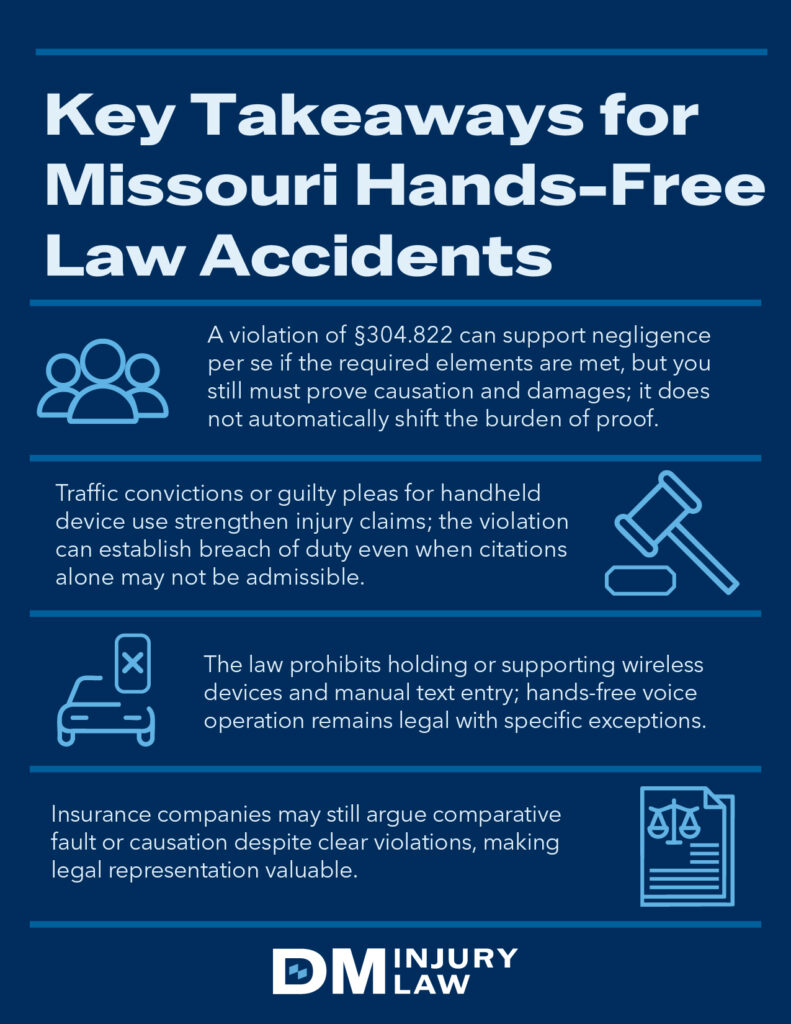
- A violation of §304.822 can support negligence per se if the required elements are met, but you still must prove causation and damages; it does not automatically shift the burden of proof.
- Traffic convictions or guilty pleas for handheld device use strengthen injury claims; the violation can establish breach of duty even when citations alone may not be admissible.
- The law prohibits holding or supporting wireless devices and manual text entry; hands-free voice operation remains legal with specific exceptions.
- Insurance companies may still argue comparative fault or causation despite clear violations, making legal representation valuable.
- Missouri and Illinois differ on comparative fault (pure vs. 51% bar) and filing deadlines (five years vs. two years), which affects strategy for cross-border crashes.
What Missouri’s Hands-Free Law Actually Prohibits
While driving in Missouri, drivers may not hold or support a device, send or read texts, or manually enter data. Voice-operated or hands-free features are allowed, subject to listed exceptions. Missouri Revised Statutes Section 304.822 establishes the Siddens Bening Hands-Free Law with these specific prohibitions. These prohibitions apply while the vehicle is in motion or stopped in traffic but not legally parked.
A driver texting at a stoplight on Lindbergh Boulevard violates the law even while stopped in traffic. Holding a device to watch videos, check social media, or read emails all constitute violations. A dash-mounted phone still violates the law if the driver types messages or manually enters navigation while the vehicle is moving.
Using a device for the sole purpose of reporting an emergency and communicating with emergency personnel is exempt from the ban. Professional exceptions apply to emergency responders and law enforcement performing official duties.
How Illinois Law Differs for Metro East Drivers
Illinois prohibits handheld use for calls and texting; hands-free is required. Missouri bars holding a device and manual input but allows voice-operated features. Illinois implemented its handheld device ban through 625 ILCS 5/12-610.2.
Understanding Negligence Per Se in Missouri Car Accidents
Negligence per se treats certain statutory violations as evidence of breach when safety statutes are involved. Meeting the required elements strengthens your claim significantly.
What Negligence Per Se Means in Plain English
Standard negligence requires proof that the driver breached the duty of reasonable care and caused harm.
Negligence per se adopts the statute as the standard of care. If you prove a violation of a safety statute designed to prevent this type of harm, that violation establishes breach, but you still must prove causation and damages. It does not automatically shift the burden of proof. The statute supplies the standard of care.
Required Elements for Negligence Per Se Claims
Missouri courts require specific elements before applying negligence per se. The violation must involve a safety statute designed to prevent the type of harm that occurred. Missouri’s hands-free law aims to prevent distracted driving accidents, so crashes caused by phone use fit this protective purpose.
The injured person must belong to the class the statute protects. Traffic safety laws protect all roadway users—drivers, passengers, pedestrians, and cyclists. The violation must cause the crash and injuries. A driver holding a phone at a stoplight who is later rear-ended shows a violation without causation.
Proof can include a conviction or guilty plea, witness statements, phone records, or the driver’s own statements. The strength of this proof affects how effectively attorneys can use negligence per se.
How This Doctrine Affects Your Claim
Once the elements of negligence per se are met, breach of the duty of care is established. This narrows disputes about reasonableness, since violating a safety statute sets the standard of care.
You still must prove the violation caused your injuries and document your damages. However, establishing breach through negligence per se strengthens your position significantly. This makes comparative fault arguments harder to sustain and increases settlement leverage.
How Traffic Convictions Strengthen Your Injury Claim
A guilty plea or conviction for violating Missouri’s hands-free law provides documented proof of the violation. Knowing how these outcomes work in civil claims helps you use this evidence effectively. Note that before January 1, 2025, violations were not a primary offense and required another traffic violation for a stop.
Convictions and Guilty Pleas as Evidence
A guilty plea or conviction may be admissible as an admission or for impeachment. While the traffic citation itself is generally not admissible in Missouri civil cases, the outcome of the traffic proceeding carries significant weight.
A conviction proves the driver violated the safety statute at the time and location of the accident. Missouri courts recognize convictions as strong evidence when the violation directly relates to accident causation. A handheld device conviction following a rear-end collision on Highway 40 creates powerful proof that distraction caused the crash.
What to Do If No Citation Was Issued at the Scene
Many distracted-driving crashes do not result in immediate citations. Officers focus on safety, medical care, and basic documentation rather than thorough phone use investigations. The absence of a ticket doesn’t eliminate your claim.
Attorneys can obtain evidence proving violations even without citations. Subpoenas to carriers can produce detailed logs showing device use at the time of the crash. These records can show calls, texts, data use, and app activity with precise timestamps.
Police reports may note phone-related observations. An officer’s note that “Driver 1 stated he was checking GPS” provides evidence supporting negligence per se even if no citation followed.
How Attorneys Use Violation Evidence in Settlement Negotiations
Insurers recognize the strength of violation evidence. Documented hands-free violations complicate their efforts to deny or minimize fault. Attorneys leverage this evidence to demand higher settlements that fully compensate injuries.
Proving a violation of a safety law aimed at preventing this kind of crash weakens comparative-fault arguments. Evidence of violations also affects potential trial outcomes, increasing jury award predictions and motivating higher settlement offers.
Proving Distraction Beyond Traffic Court Outcomes
Convictions provide strong evidence, but comprehensive claims require multiple proof sources. Building thorough documentation helps you seek full and fair compensation even when convictions weren’t obtained or face challenges.
Cell Phone Records and Subpoenas
Phone records offer objective, timestamped evidence of device use. Call logs reveal active conversations during accidents. Text message timestamps showing messages sent seconds before crashes establish manual device operation. Data usage records expose internet browsing, app use, and social media activity at crash moments.
Witness Testimony About Observed Phone Use
Eyewitnesses can provide specific observations of driver behavior. Other motorists notice drivers looking down, holding devices, or showing delayed reactions characteristic of distraction. Effective witness statements describe specific observations like “The driver was holding a phone to their ear” rather than vague claims about distraction.
Accident Scene Evidence and Reconstruction
Physical evidence can show collision dynamics consistent with distraction. Reconstruction experts link those patterns to driver behavior. Multiple evidence types combine to prove device use caused the collision:
- Absence or presence of skid marks and braking data
- Crush profiles and impact angles on involved vehicles
- Time-stamped traffic or business camera footage
- Available dashcam video from involved or nearby vehicles
How Insurance Companies Respond to Hands-Free Violations
Insurers know hands-free violations create liability risk and use tactics to reduce their impact on settlement value.
Common Arguments
Insurers often acknowledge a violation but still contest liability or damages. The most frequent arguments aim to disconnect the phone use from the crash or to shift part of the blame to you. Insurance adjusters typically raise several predictable objections:
- Violations don’t automatically prove causation; other factors allegedly caused the crash
- Comparative fault claims (e.g., minor speeding or late braking) to reduce your percentage recovery
- Disputes over the timing of phone use vs. the moment of impact
- Challenges to witness reliability or phone record interpretation
These arguments call for evidence that directly ties device use to causation. Strong documentation that directly connects phone use to collision dynamics effectively counters these defensive tactics.
Why Legal Representation Matters for These Cases
Attorneys counter insurance tactics by building comprehensive evidence packages combining violation proof with phone records, witness statements, and expert opinions. This thorough approach helps fight comparative fault arguments and increase settlement values.
Legal representation also ensures proper damage documentation. Negotiation leverage increases with litigation readiness. Attorneys who prepare cases for trial and demonstrate a willingness to pursue verdicts compel fair settlement offers.
Comparing Missouri and Illinois Laws for Metro East Accidents
Cross-border crashes in the St. Louis area often involve both Missouri and Illinois law, which affects liability analysis and strategy.
Which State’s Law Applies to Your Accident
The accident location often controls, but Missouri applies the “most significant relationship” test; courts may apply the law of another state if it has a closer connection to the issues. Crashes occurring on Missouri roadways typically fall under §304.822. Accidents on Illinois roads typically use 625 ILCS 5/12-610.2.
This distinction matters for Poplar Street Bridge accidents and crashes near state borders. Both states recognize negligence per se doctrines. Missouri uses pure comparative fault, while Illinois uses modified comparative fault with a 51% bar (no recovery if you are more than 50% at fault).
Statute of Limitations Differences Between States
Missouri allows five years from the accident date to file personal injury lawsuits under Missouri Revised Statutes Section 516.120. Illinois provides only two years under 735 ILCS 5/13-202. Illinois accidents require faster action to preserve legal rights.
Early attorney consultation ensures proper jurisdiction analysis and timely action. Determining which state’s law applies affects both liability analysis and procedural deadlines.
Damage Caps
Missouri has no general noneconomic damages cap for auto cases; medical malpractice claims are capped by statute (§538.210) with amounts adjusted annually. Illinois has no general cap on noneconomic damages, and the Illinois Supreme Court struck down broad caps in Best v. Taylor (1997) and medical malpractice caps in Lebron v. Gottlieb (2010).
Steps to Take After an Accident Involving Phone Use
Post-accident follow-up can affect claim strength in phone-use cases. Proper documentation preserves evidence proving distraction and supports negligence per se claims:
- If it was not documented at the scene, contact the appropriate agency’s non-emergency line to add your observation about the other driver’s device use to the report.
- Document your own observations immediately by writing down exactly what you saw—hand positions, phone type, whether the driver was texting or talking, and their reaction time.
- Seek immediate medical evaluation even for seemingly minor injuries, as prompt treatment documents injury severity.
These steps create contemporaneous evidence that attorneys use when building negligence per se claims. Thorough documentation strengthens your claim significantly.
FAQ for Missouri Hands-Free Law Accidents
Does a hands-free violation automatically make the other driver 100% at fault?
A violation that meets negligence per se requirements proves breach of duty but doesn’t automatically eliminate comparative fault analysis. Missouri uses pure comparative fault, allowing recovery even if you share some responsibility. The hands-free violation establishes the other driver breached their duty of care, but insurance companies may still argue you contributed through speeding or following too closely. Strong violations with clear causation typically result in high fault percentages assigned to the distracted driver.
Can dashcam or business security footage help my case?
Yes. Time-stamped dashcam, traffic, or business surveillance can show device use, driver attention, or impact sequence. Preserve footage immediately by saving your own files and requesting copies from nearby businesses with exact time windows. This visual evidence can provide clear proof of phone use and reduce disputes about the driver’s actions at impact.
What Missouri or Illinois records should I request after I’m home?
Request the police crash report and any supplemental narratives, ask your carrier for claim notes relevant to liability, and keep copies of medical visit summaries and billing statements to document injuries and costs. These records form the foundation of your claim and help attorneys build comprehensive evidence packages. Early collection prevents loss of critical documentation as time passes.
Protect Your Rights After a Distracted Driving Accident
Missouri’s hands-free law creates powerful tools for holding negligent drivers accountable. Negligence per se establishes breach of duty when violations meet the required elements, strengthening injury claims significantly.
DM Injury Law’s St. Louis team knows how to leverage hands-free violations for maximum compensation. Our attorneys obtain phone records, interview witnesses, secure expert testimony, and counter insurance tactics that minimize clear violations. We build comprehensive cases that deliver results.
If you’ve been injured by a driver who violated Missouri’s hands-free law, don’t let insurance companies downplay this clear negligence. Contact DM Injury Law at (314) 300-0314 for a free consultation or contact us online. We’re available 24/7 and don’t get paid unless we win.
Past results do not guarantee future outcomes. Every case is different and must be evaluated on its own facts.
Call (314) 300-0314 or contact us online today for a free consultation.