



If a DoorDash or Uber Eats driver rear-ends you at a red light, figuring out who pays for your damages shouldn’t be complicated. Unfortunately, however, it is because of a coverage gap baked into how these apps structure their insurance.
Here’s the problem: The driver’s personal auto insurance almost certainly won’t cover the crash. Standard policies exclude accidents that happen while using a vehicle for commercial purposes, and delivering food for money counts as commercial use. But the app’s commercial insurance—the $1 million policy DoorDash and Uber Eats advertise—only kicks in during certain phases of a delivery. If the driver had the app open but hadn’t accepted an order yet, that million-dollar policy doesn’t apply. You’re left with a much smaller contingent policy, or possibly nothing at all.
Which policy covers your accident depends entirely on what was happening on the driver’s phone at the moment of impact. Was the app off? Was the driver waiting for a request? Had they accepted an order but not picked up the food yet? Were they en route to a customer’s house? Each scenario triggers different coverage or no coverage.
Sorting this out requires pulling the driver’s app data, identifying exactly which period they were in, and knowing how to work the coverage rules in your favor. If you’ve been hit by a delivery driver, call DM Injury Law for a free consultation. We’ll help you figure out which policy applies and how to get your damages covered.
Call (314) 557-4659 or contact us online today for a free consultation.
Key Takeaways for Food Delivery Accidents
- Liability depends on the driver’s app status. Whether you can access the company’s $1 million commercial policy or are left with a lower-limit policy is determined by whether the driver was waiting for, heading to, or actively completing an order at the moment of the crash.
- The “independent contractor” label is a defense, not a fact. Delivery companies use this classification to avoid responsibility, but we can challenge it by investigating the level of control the app exerts over the driver’s work.
- State laws in Missouri and Kansas dramatically affect your claim. The rules for assigning fault (comparative negligence) are different in each state, which directly impacts your ability to recover compensation if you are found partially to blame for the accident.
The Gig Economy Liability Shield: Why These Accidents Are Legally Distinct
The fundamental difference between being hit by a FedEx truck and a DoorDash car comes down to employment classification. FedEx drivers are typically considered employees, while gig workers for apps like Uber Eats and Grubhub are classified as independent contractors. This distinction is the cornerstone of the tech companies’ legal defense.
This matters because of a legal concept called respondeat superior, a Latin phrase that means “let the master answer.” It holds an employer responsible for the wrongful acts of an employee, provided those acts occur within the scope of employment.
By classifying their drivers as independent contractors, the gig platforms attempt to sever this link, shielding their corporate assets from your injury claim. The financial burden is instead shifted to the driver’s personal policy—which, as mentioned, likely excludes commercial work, leaving you to face a driver with no effective insurance.
With meal delivery sales growing and more people joining the gig economy, the frequency of these accidents is rising. The contractor label, however, should not be accepted at face value. A skilled personal injury lawyer will investigate the degree of control the app platform exerted over the driver to challenge this classification and hold the parent company accountable.
The Three-Period Insurance Framework: Determining Who Pays
The most important factor in your case is what was displayed on their phone screen at the moment of the crash.
The insurance coverage provided by delivery apps is segmented into different phases, commonly known as the three-period system. The amount of available coverage and who provides it changes instantly as the driver moves between these periods.
- Period 0 (App Off): The driver is considered a private citizen. If their app is off, they are not working. In this situation, their personal auto insurance policy should apply, just as it would in any other car accident.
- Period 1 (App On, Waiting for Request): This is the danger zone. The driver has logged into the app and is available to accept work, so their personal auto insurer will deny the claim based on the business use exclusion. However, because they have not yet accepted a delivery request, the app’s full commercial policy has not been triggered. The apps usually provide a contingent liability policy in this period with lower limits (for example, $50,000 for bodily injury per person, $100,000 per accident, and $25,000 for property damage), but this coverage only applies after the driver’s personal insurance issues a formal denial.
- Period 2 (Request Accepted, En Route to Restaurant) & Period 3 (Food in Car, En Route to Customer): This is the golden period for an injury victim. Once the driver accepts a delivery request, the app’s full commercial liability policy (typically offering $1 million in coverage) is active. This policy remains in place until the delivery is completed or canceled.
Was the Driver in Period 1 or 2?
This is the central question we need to answer. To complicate matters, many drivers practice multi-apping—running Uber Eats and DoorDash simultaneously to maximize their income. If an accident occurs, both companies might try to deny liability, claiming the driver was not active on their platform. You should not rely on the driver’s word, as they may be incentivized to be less than truthful to protect their job.
Legal intervention is frequently required to get the truth. Our firm subpoenas timestamped data logs and metadata from the app’s servers to prove exactly which period the driver was in at the time of the collision.
Piercing the Corporate Veil: Negligence Beyond the Driver
What happens if the driver was in Period 1 and the lower policy limits aren’t enough to cover your injuries? Or what if the app successfully denies the driver was active at all? In these cases, we must look beyond the driver’s actions and investigate whether the platform itself was negligent.
Several arguments for direct liability may exist:
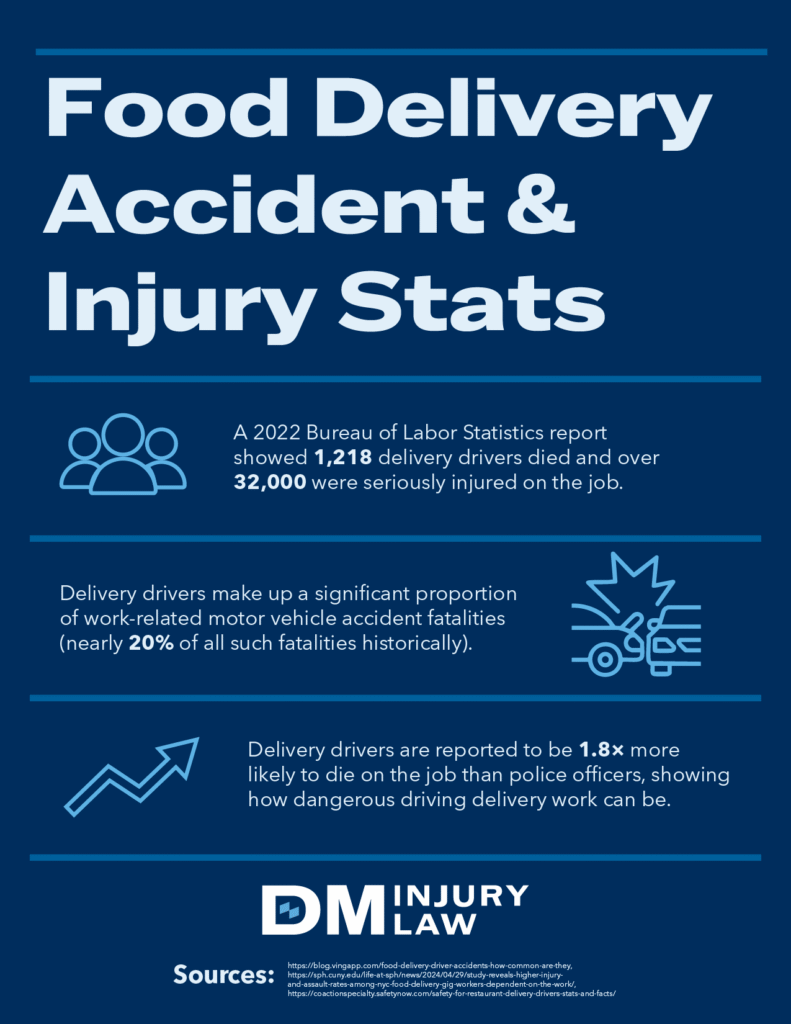
- Negligent Hiring and Retention: Did the app conduct a proper background check on the driver? Did they ignore a history of DUIs, reckless driving citations, or other red flags? According to the U.S. Bureau of Labor Statistics, workers in transportation occupations suffer the most fatal injuries of any job sector. If an app platform ignores a driver’s dangerous history, they may be held liable for their own negligence in putting that driver on the road, regardless of the independent contractor status.
- Incentivizing Reckless Behavior: App algorithms typically include on-time demands or bonus structures that reward speed. If the system penalizes drivers for being late or stuck in traffic, it may be argued that the company is encouraging unsafe driving practices like speeding or running red lights.
- Designed for Distraction: The very nature of a food delivery app requires a driver to interact with their phone while operating a vehicle. They must accept orders within seconds, check order details, and manage navigation. We would argue that this system constitutes a form of operational negligence or a design defect that contributes to distracted driving accidents.
When we take on a case, we review the driver’s entire history with the platform. Our goal is to find patterns of negligence that the company knew about, or should have known about, and failed to address.
Handling the Midwest Legal Landscape: MO & KS Specifics
Insurance and liability laws are state-specific. A legal strategy that is effective in Kansas City, Missouri, might not apply just a few miles away in Overland Park, Kansas. Understanding these local nuances is key to protecting your rights.
Two of the most significant differences between the states involve fault and insurance stacking:
- Comparative Fault Rules:
- In Missouri, the law follows a pure comparative fault standard. This means you may recover damages even if you were partially responsible for the accident, though your recovery will be reduced by your percentage of fault. Even if you are found 99% at fault, you could still recover 1% of your damages.
- Kansas uses a modified comparative fault rule. Under this system, you are barred from recovering any damages if you are found to be 50% or more at fault for the crash. This makes the investigation phase, where we gather evidence to prove the other driver’s fault, particularly important in Kansas cases.
- Uninsured/Underinsured Motorist (UM/UIM) Coverage:
- When the at-fault delivery driver has insufficient insurance (or none that applies), your own UM/UIM policy may be a source of recovery. Missouri law sometimes allows for the stacking of UM/UIM policies, which means you may be able to combine the coverage limits from multiple vehicles on your personal auto policy.
- Kansas law, conversely, generally prohibits stacking. This makes identifying every possible source of third-party coverage even more important.
We apply our experience with these local statutes to every case, exploring household insurance policies, umbrella policies, and other potential sources to ensure every avenue for compensation is pursued.
Call (314) 557-4659 or contact us online today for a free consultation.
Calculating Damages: The True Cost of a Delivery Crash
Initial personal injury settlement offers from gig companies and their insurers are frequently generated by algorithms designed to pay out as little as possible. These offers rarely account for the full and true cost of an accident.
Even a seemingly minor whiplash injury or a broken bone can have significant financial ripples that last for years. A comprehensive damages calculation should include:
- Current and Future Medical Costs: This goes beyond the initial emergency room bill to include costs for physical therapy, chiropractic care, future surgeries, and prescription medications.
- Lost Wages and Earning Capacity: This includes not only the paychecks you missed while recovering but also the potential impact on your ability to earn a living in the future if you are left with a long-term impairment.
- Non-Economic Damages: This legal term refers to compensation for the human cost of the accident, including physical pain, emotional distress, and loss of enjoyment of life.
With a $1 million policy potentially in play during Periods 2 and 3, the defense will work hard to dispute the value of your injuries. They may argue your pain is exaggerated or that your injuries were pre-existing. We work with medical professionals and financial planners to forecast your future care costs and prove the lifetime impact of the accident, ensuring any settlement fully accounts for your pain and suffering damages.
FAQ for Food Delivery Accidents in Missouri and Kansas
Can I sue the restaurant that made the food?
Usually, no. However, liability might extend to the restaurant in very specific circumstances, such as if they knowingly served alcohol to an intoxicated delivery driver who then caused a drunk driving accident.
What happens if the delivery driver drives away (Hit and Run)?
If the driver cannot be identified, your primary source of recovery will likely be your own Uninsured Motorist (UM) coverage. File a police report immediately and notify your own insurance company.
The driver offered to pay me cash not to report it to DoorDash. Should I accept?
Absolutely not. Accepting a cash payment is a risky proposition. You may not know the full extent of your injuries or vehicle damage right away, and once you accept the money, you forfeit your right to pursue further compensation. Always report the accident.
Does my own health insurance cover me while I wait for the settlement?
Yes, you should use your health insurance for your medical treatment. However, be aware that your health insurer will likely seek reimbursement from any settlement you receive. This process is called subrogation in personal injury claim.
I was the delivery driver and I got hit. Do I get Workers’ Comp?
As an independent contractor, you are not eligible for workers’ compensation benefits. Your recovery will depend on filing a claim against the at-fault driver’s insurance policy or using your own Personal Injury Protection (PIP) or Medical Payments coverage if you have it.
Don’t Let an App Algorithm Dictate Your Recovery
You may worry that taking on a massive tech company to get fair compensation is an impossible task. It isn’t. It simply requires a legal team who understands the digital footprint of the accident as well as the physical one.
If you are unsure which insurance policy applies after your accident, let us review the facts of your case. Call DM Injury Law today to ensure every potential avenue for compensation is explored. We are ready to help you move forward.
Call (314) 557-4659 or contact us online today for a free consultation.